

 Monuments
The Maiden Tower
 The Maiden Tower

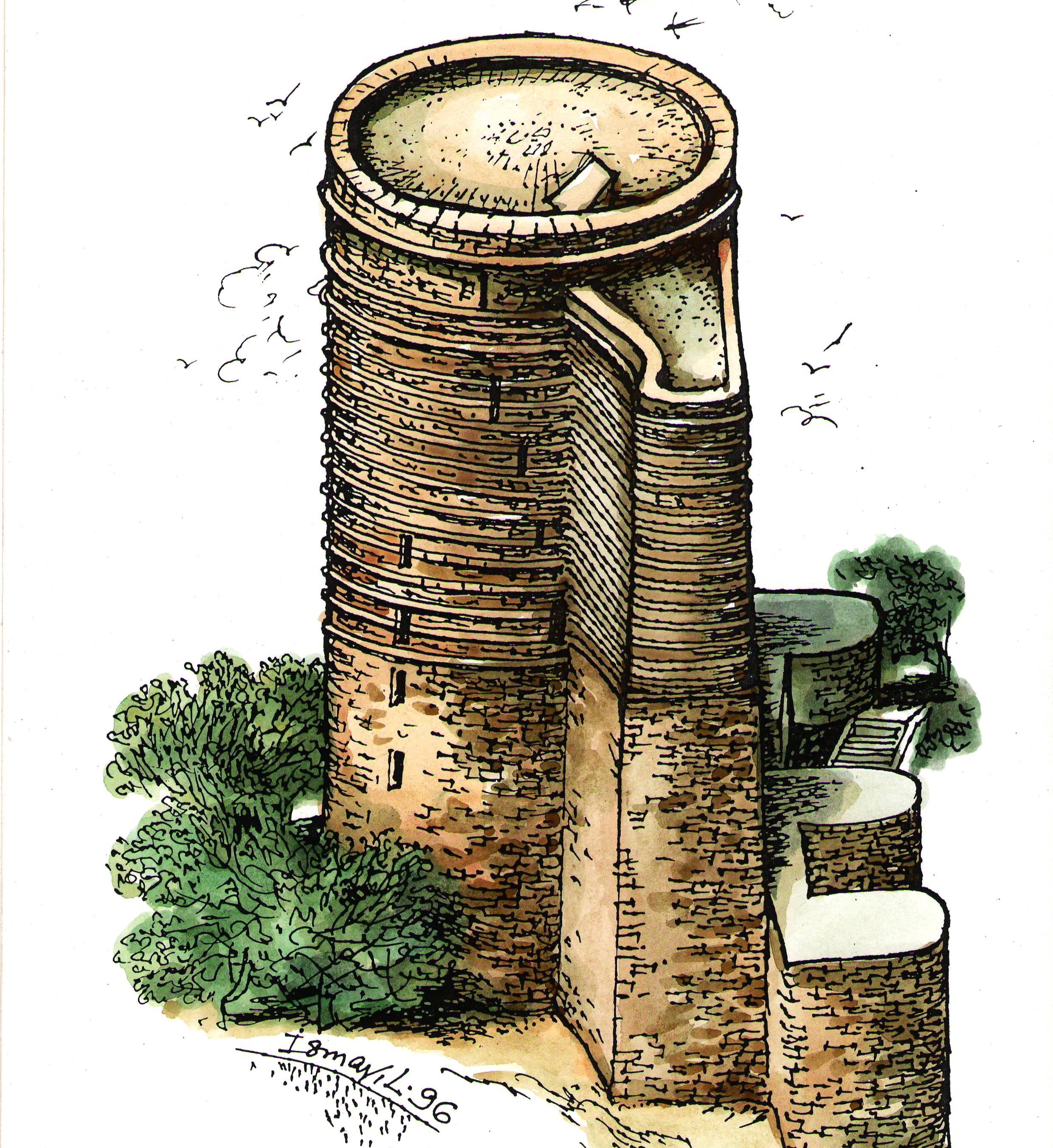
The Maiden Tower is a large stone cylinder built on a ledge of a coastal cliff. Its height is 28 m on one side and 31 m on the other, and its diameter is 16.5 m. The thickness of the walls is 5 m at the bottom and 4.5 m at the top.
The inscription written in Kufic script at a height of 14 m on the tower reads: “The tower of Masud ibn Davud”. According to the paleographic features of the inscription, it is attributed to the 12th century. Some scholars consider Masud to be one of the Seljuks of Iraq and assume that the Maiden Tower was built in the 12th century during the Seljuks’ rule in Azerbaijan. However, the upper part of the tower is identical to the central tower of “Chirag Gala” (6th century), located in the Davachi region and built during the Sassanid period. Therefore, some scholars assume that the tower was built in two different periods. According to this assumption, the lower part of the fortress, with a smooth wall 12 m high, is believed to have been built in the 8th-7th centuries BC, while the upper part, surrounded by a stone belt, was built later, in the 6th century.
Scientific hypotheses about the origin of the Maiden Tower
According to some hypotheses, the Maiden Tower is a Turkic fire worship temple, observatory, lighthouse, defensive fortification, Zoroastrian hut.
Some scholars consider the Maiden Tower to be a fortification included in the general defense system of the Shirvanshahs and note that it was used to transmit alarm signals to other fortresses from the tower in case of danger. In the Middle Ages, there were up to 30 such fortresses in Absheron. Several of them have survived to our time. (Mardakan, Ramana, Nardaran). According to scholars, thick walls, a water well placed inside the wall and not visible from the 1st floor could only have been in the defensive fortress.
According to another hypothesis, in these territories in the middle of the 7th century BC, fire worship traditions of the Cimmerian-Scythian (Turkic) tribes existed. The difference in the understanding of fire between the ancient Turks and Zoroastrians was that the ancient Turks considered fire to be a force that protects the hearth, drives away evil forces, and connects people with their ancestors, and they worshiped it. The Zoroastrians, on the other hand, fetishized fire, worshiped fire as an idol, and perceived the flame as a symbol of justice. Only high-ranking priests could communicate with fire. Unlike the Zoroastrians, the Turkic fire worshipers had a fire god called Tabiti, and they worshiped him. According to this hypothesis, the Maiden Tower is a religious monument that arose before Zoroastrianism. It seems that this fire-sprinkling land was a sacred place like Mecca for fire worshipers before and after Zoroastrianism for a long time, until the Arab Caliphate captured Absheron. Supporters of this scientific opinion believe that the Maiden Tower was built according to the ancient style of the Caspian, Alban, and Median priest-architects and was built on the burning shores of Absheron as a copy of the ancient temple of Ahura Mazda. During the Zoroastrian era, such temples were no longer built. Therefore, they attribute the Maiden Tower to the VIII-VII centuries BC. The remains of numerous fire-worshiping temples located around the tower confirm this idea.
According to a number of scholars, this is a Zoroastrian hut. They placed their deceased compatriots on top of the tower, fed them to birds, and then lowered their bones to the ground through pipes located in the wall and buried them.
Legends about the Maiden Tower
Since ancient times, various legends and stories have been told about the Maiden Tower. According to one of these legends, the ancient city, surrounded by double fortress walls, was besieged by the troops of the Iranian Shah Nureddin for 90 days. In the Zoroastrian temple located within the fortress walls, prayers were recited for the salvation of the land of fire from the enemy. One day, after a religious service, the chief priest of the fire temple announced to the fire worshipers: "Tomorrow the king will be killed. A weak force will kill him." At this time, the doors of the temple open and a long-haired divine girl with a fiery sword in her hand enters. The girl approaches the chief priest. The priest tells the girl that she must save the land of fire and the holy temple from the enemy. The girl comes to the room of Nureddin Shah and kills him with a sword. The girl saves her people from the enemy, but she herself is madly in love with the enemy commander. After the death of her lover, the girl, who did not want to live, killed herself by stabbing her sword in the chest in front of the temple gates. At that moment, a strong wind arose and the fire in the temple went out. Since then, this castle has been called the Maiden's Tower.
Another legend tells of the beautiful love between the shah's daughter and the fisherman. Every day, the fisherman comes to the Maiden Tower to see his lover. The fisherman walks on the surface of the sea. This strength gives him faith in this love. One day, while returning from a meeting with his lover, doubts arise in the heart of the fisherman about this love, and he begins to sink. Seeing his lover sinking, the shah's daughter throws herself from the tower into the sea to save him. However, the fear in her heart is stronger than the faith in love, so she drowns in the water. Since then, the Maiden's Tower has become a symbol of love and purity.
Another legend connects the Maiden's Tower with the name of the water goddess Anahid (the Arabs call her Zohra, and the Turks call her Yagut, the Morning Star). God sent her down to earth to bring water to people. According to legend, two angels named Marut and Harut are sent down to earth one day. Both of them are attracted to Anahid and secretly declare their love for her. Anahid puts them in a well and ascends to heaven. Since then, the inhabitants of the ancient world have built temples in honor of Anahid, who has ascended to heaven, and worship her. In the East, such sacred places are called Maiden Tower. During archaeological excavations, a bronze fish figurine was discovered on the shore of the "Maiden Tower". The head of this figurine, which dates back to antiquity, is in the shape of a dolphin. In antiquity, the dolphin was considered the sacred animal of the Sea God. The discovery of this figurine near Maiden Tower suggests that this tower probably functioned as a temple of the water god at a certain historical period.
UNESCO heritage
The Maiden Tower was included in the UNESCO World Heritage List in 2000.