


“Gala” State Historical and Ethnographic Reserve
 "Gala" State Historical Ethnographic Reserve

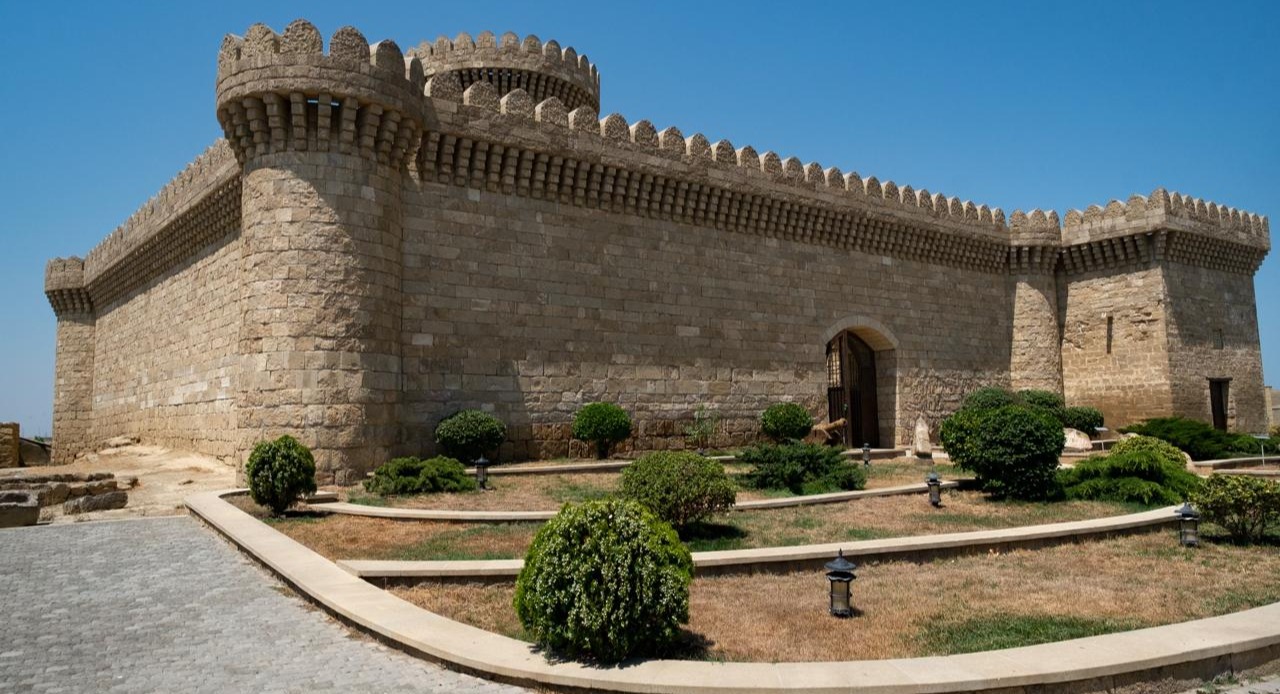
The “Qala” State Historical and Ethnographic Reserve is one of the most significant historical monuments of our country. The reserve encompasses the Qala Fortress dating back to the 14th–15th centuries, ancient residential houses, mausoleums and mosques, the Samovar and Antique Objects Museum , which brings together various examples of traditional craftsmanship, rock carvings, and the Archaeological and Ethnographic Museum.
The “Qala” State Historical and Ethnographic Reserve was established in 1988 and covers an area of 81.5 hectares. The museum complex presents exhibitions reflecting the five-thousand-year history of Absheron, the customs and traditions, worldview, and lifestyle of ancient people.
Monuments of the Bronze Age of Eastern Absheron, including kurgans and dolmens, rock carvings, and other archaeological features, have been restored and are displayed in their original appearance.
At the Samovar and Antique Objects Museum, 800 items from the collection of restorer and philanthropist Shahid Habibullayev are on display.
Another monument located within the reserve is the Qala Fortress, dating back to the 14th–15th centuries.
Archaeological excavations conducted in the area surrounding the fortress have revealed medieval residential houses, remains of tandoors, fragments of painted and unpainted ceramics, iron tools, and other artifacts. These findings demonstrate that during the Middle Ages the population of Qala was densely and systematically settled around the fortress.
Mosques of the “Qala” State Historical and Ethnographic Reserve
The Juma Mosque is located in the Balaverdi quarter of Qala. The monument dates back to the 17th century. The Juma Mosque has a very simple architectural design, and its decorative elements have not been preserved. The building has two entrance doors, one intended for men and the other for women.
The Balaverdi Quarter Mosque is situated in the eastern part of Qala village, in the Balaverdi quarter. It was built in 1864 by Karbalayi Suleyman. Above the entrance door, there is an inscription indicating that the mosque was restored by a person named Balaverdi, from whom the mosque takes its name.
The Haji Ramazan Mosque is a neighborhood mosque built in 1842–1843.
The Chambarakend Quarter Mosque has a square plan in terms of its architectural layout.
The Tarakama Quarter Mosque is located in the northern part of Qala village. As the only monumental structure in the quarter, this mosque was constructed in the 17th–18th centuries. The central part of the prayer hall is crowned with a dome. The mosque has a small entrance with a pointed arch.
The Chambarakend Quarter Mosque has two prayer halls, each with a separate entrance. An inscription above one of the entrances indicates that the mosque was built in 1911. The central part of the mosque is completed with a dome.
Hammams of the “Qala” State Historical and Ethnographic Reserve
According to the epigraphic inscription above the entrance, the Bayramali Hammam was restored in 1881 by a person named Bayramali. The bathhouse consists of two sections.
The Sand Hammam dates back to the 12th–14th centuries, based on its architectural features. As it is located underground, it is known as the “Sand Hammam.”
The Shor Hammam is located in the southern part of Qala village, near a salt lake. Due to its saline water, the bathhouse was mainly used for therapeutic purposes. The structure has been destroyed, and only its foundation has survived to the present day. The monument dates to the 18th century.
Services at the “Qala” State Historical and Ethnographic Reserve
By visiting the “Qala” State Historical and Ethnographic Reserve, you can take part in traditional crafts such as carpet weaving, pottery, and blacksmithing at the open-air Archaeological and Ethnographic Museum Complex.
Visitors have the opportunity to learn the secrets of the ancient patchwork craft, bake lavash bread with their own hands, apply various designs using henna (a natural hair dye), explore rock carvings, and become acquainted with medieval residential sites. If you wish to feed camels, ponies, Qala-breed sheep, and other animals, be sure to visit our reserve.
You can also discover craft samples produced in Azerbaijan and various countries around the world at the Antiques Museum, and climb the medieval fortress to enjoy a breathtaking view of the unique beauty of the Qala Reserve from above.
We warmly invite you to visit the Qala Reserve and experience its rich history and living traditions.


